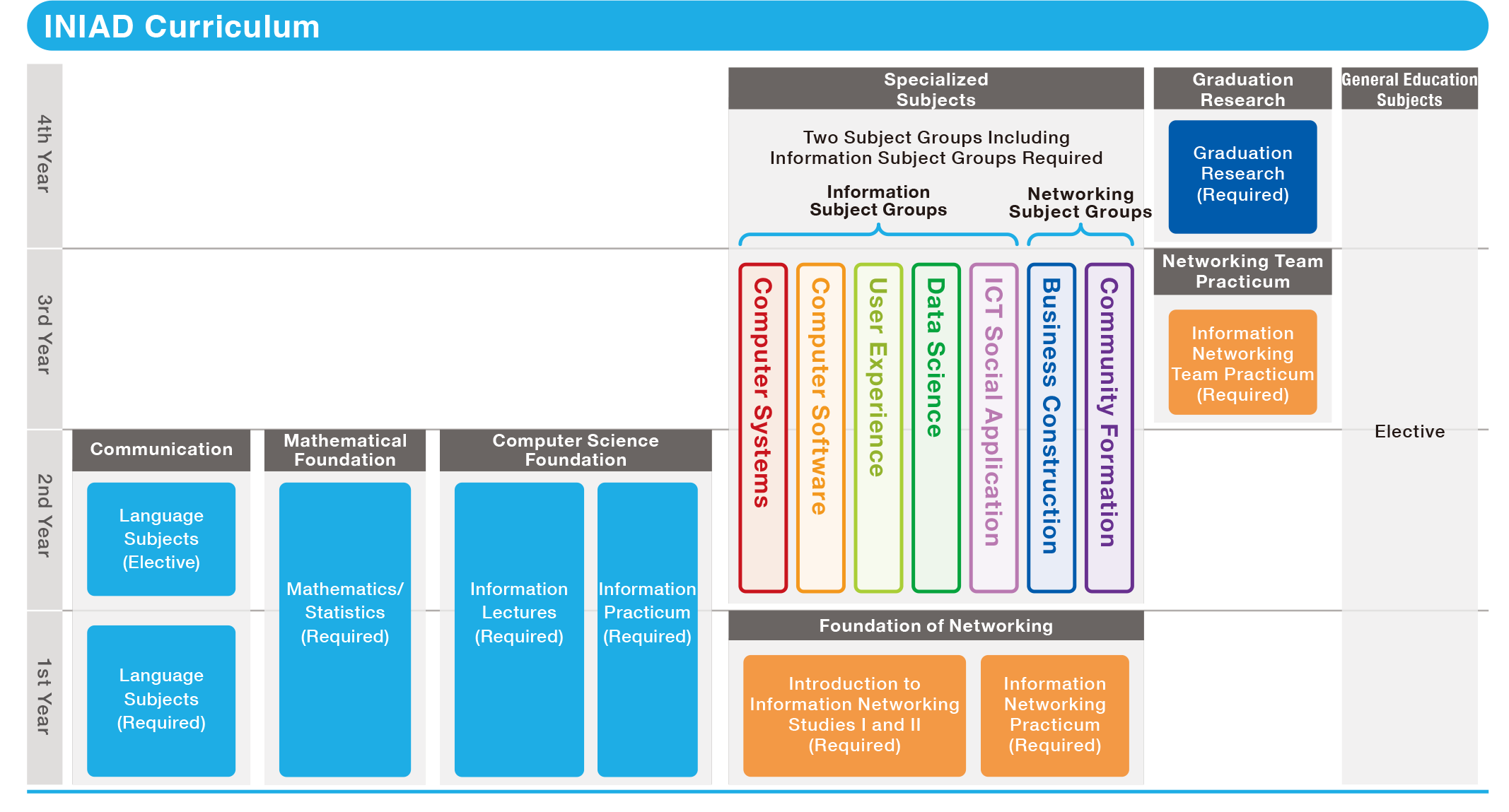
Now that transformation through digital technology, DX (Digital Transformation), has become society’s keyword, digital technologies including IoT and generative AI are evolving at a remarkable speed every day. To produce human resources who can contribute to such a world, university “education” also needs to constantly continue changing.Starting in 2022, five years after establishment, INIAD significantly updated its curriculum.
Programming, Mathematics, and Communication as the Foundation of Networking
From the 1st to 2nd year, all students intensively study programming, mathematics (mathematics and probability/statistics), and communication, acquiring the foundation of information networking. Now that society as a whole is becoming globally connected, we also need skills to “network” with people around the world and solve various challenges.
At INIAD, immediately after enrollment, students learn “Python,” a programming language used worldwide, and the web standard languages “HTML,” “CSS,” and “JavaScript.” Based on these fundamental skills, all students master team web service development using the source program management system “Git” and the basics of data analysis and AI utilization with Python by the end of their second year.
In learning, students use “AI-MOP,” INIAD’s unique educational system utilizing generative AI. Students learn not to simply seek answers from AI, but to deepen their own understanding with AI as a partner.
Specialized Subject Groups Shaping Future Portfolios
From the second year, students select two from the seven subject groups offered by INIAD and study specialized subjects. Whether it’s “I want to become an engineer mastering cutting-edge technologies from IoT to cloud technology,” “I want to start a new business utilizing big data and generative AI,” or “I want to promote DX in local communities,” students select subject groups connected to their future and study those fields deeply.
Team Practicum
“Information Networking Team Practicum” is set as a required subject for third-year undergraduates. Students bring together the specialized knowledge and skills from the subject groups they began studying in their second year, form cross-faculty teams of about 5 people, autonomously plan projects, and execute them over one year. This is a unique initiative characteristic of INIAD, which emphasizes “networking ability.”
In actual society, it’s necessary to cooperate with colleagues who have different strengths from oneself. In particular, many ICT businesses in society, including startups, are created through cooperation among people with various roles, including engineers, designers, and project managers. This is a “practicum” aimed at experiencing such “society” in simulation and understanding the significance of contribution or its difficulties.
Graduation Research
In the fourth year, students belong to faculty research laboratories and work on specialized research themes over one year. Of course, they can also advance to graduate school and engage in more full-scale research activities aiming to become researchers.
INIAD’s Seven Subject Groups
Modern society, highly digitalized, is supported by countless computers and their networks. Even cutting-edge AI technologies are sustained by massive computer resources. To build information systems in this IoT + AI era, a systematic understanding of computer science is required, from OS (Operating Systems) to networks. In the Computer System Subject Group, students acquire the knowledge and skills to build state-of-the-art information systems themselves.
(Subject Examples)
"Programming Languages" "Computer Architecture" "Operating Systems" "Computer Networks"
To realize DX, it’s necessary to be able to analyze various social challenges and design and develop information services that solve them. Furthermore, in the rapidly changing modern era, it’s expected to quickly launch information services and continuously develop them, requiring mastery of software development methods for this purpose. The Computer Software Subject Group provides knowledge and skills for designing and developing modern information services.
(Subject Examples)
"Algorithms and Data Structures" "Databases" "Software Engineering" "Cybersecurity"
Attractive UX design is essential for information services that captivate people. The User Experience Subject Group provides deep learning about design concerning “the relationship between people and computers” after learning basic design knowledge, and practical knowledge and skills for giving form to new ideas.
(Subject Examples)
"Algorithms and Data Structures" "Databases" "Software Engineering" "Cybersecurity"
In modern society, the massive amounts of data constantly being generated worldwide have become the source of DX. The ability to interpret this big data and connect it to solving social challenges is an indispensable capability in all business fields going forward. The Data Science Subject Group provides knowledge and skills for analyzing big data using machine learning and AI (artificial intelligence) technologies based on statistical analysis knowledge.
(Subject Examples)
"Data Science Fundamentals" "Data Mining Theory"
"Machine Learning and Artificial Intelligence" "Deep Learning"
Now that DX is required in all fields, computer science knowledge including programming becomes a major advantage no matter what field you work in the future. The ICT Social Application Subject Group focuses on learning particularly about the application of ICT (Information and Communication Technology) to real society, based on programming that all INIAD students learn.
(Subject Examples)
"Computer Systems Social Application Theory" "Computer Software Social Application Theory" "User Experience Social Application Theory" "Data Science Social Application Theory"
Computers are now available to everyone, and we’ve entered an era where anyone can create new services and products if they acquire the knowledge and skills, even without special qualifications or expensive equipment. Systems for launching new businesses in unprecedented forms using the Internet, such as crowdfunding from unspecified masses worldwide, are continuously emerging. The Business Construction Subject Group nurtures human resources who have the mindset to challenge repeatedly, can lead teams, and can build new ICT businesses.
(Subject Examples)
"Business Construction Fundamentals" "Management Theory" "Marketing" "System Design Theory"
Currently, initiatives called smart cities are being undertaken worldwide, where cutting-edge technology supports the increasingly complex and sophisticated activities of cities. ICT utilization in regions and communities is becoming increasingly active for infrastructure design and management, environmental consideration, health, and realizing comfortable and convenient living, enabling the creation of rich lifestyles. The Community Formation Subject Group enables students to acquire fundamental thinking about regional and community formation utilizing ICT.
(Subject Examples)
"Regional and Community Analysis" "Regional and Community Creation" "Sustainable Society Formation" "Public Space and Community Design"
Ideal Graduate Profiles
At INIAD, you can select two of the seven subject groups according to your vision for the future. The following are just examples of possible combinations.
To become an engineer
- “Computer Systems Subject Group” × “Computer Software Subject Group” Aim to become a software engineer who can design and develop information systems by systematically learning computer science.
- “Computer Software Subject Group” × “Data Science Subject Group” Aim to become an engineer who can develop cutting-edge information services that make full use of AI/IoT.

To become a community builder
- “Community Formation Subject Group” × “Data Science Subject Group” Aim to become a professional who leads DX for national and local governments by utilizing GIS and big data.
- “Community Formation Subject Group” × “ICT Social Application Subject Group” Aim to become a professional who can apply information and communication technology to form regional communities and build urban services.

To become a designer
- “User Experience Subject Group” × “Computer Software Subject Group” Aim to become a professional who can handle UX design for Web services.
- “User Experience Subject Group” × “Community Formation Subject Group” Aim to become a professional who can leverage cutting-edge technologies like AR/VR for spatial design and the design of products and services.
To become a business builder
- “Business Construction Subject Group” × “Data Science Subject Group” Aim to become a professional who can lead corporate DX by utilizing big data.
- “Business Construction Subject Group” × “ICT Social Application Subject Group” Aim to become a professional who can develop innovative businesses by applying ICT.